- eco-nnect
- Posts
- 🦋 On butterflies, ozone and solutions
🦋 On butterflies, ozone and solutions
while many fungi are disappearing

Gaia Solaris
April 04, 2025
Dear ozone layer protectors,
This week’s headlines are a wake-up call: More than half of the UK’s butterfly species are in decline. Nearly a third of fungi assessed by the IUCN are at risk of extinction. And if the planet heats up by 4°C, the average person could be 40% poorer.
But here’s the thing—we’re not powerless, solutions exist. People are fighting back with innovation, resilience, and a refusal to accept collapse as inevitable.
Now is the time to amplify these efforts. To challenge industries that exploit, governments that stall, and misinformation that blinds us. The world is changing really fast. Let’s make sure it’s for the better.
🗞️ In Climate News
🇬🇧 More than half of UK's butterfly species are in long-term decline
The UK Butterfly Monitoring Scheme said that 31 of 59 species have had their numbers fall since 1976, when monitoring began.
It also found that 2024 was the fifth-worst year for butterfly numbers across the country, with all but eight species suffering declines on the previous year - though populations can fluctuate year-on-year in response to the weather.
🍄 Nearly one-third of fungi on IUCN Red List are threatened with extinction
The International Union for Conservation of Nature (IUCN) recently updated its Red List of Threatened Species to include an additional 482 fungi, bringing the total to roughly 1,300 species of mushrooms, puffballs and other fungi. More than 400 of the species assessed are at risk of extinction, primarily threatened by agricultural expansion, deforestation and climate change, according to the IUCN’s latest update.
🥩 An oil-rich West African island offers decades of insight into the wild meat trade
The volcanic island of Bioko, about 160 kilometers northwest of mainland Equatorial Guinea, is carpeted in lush green tropical rainforest. This forest is home to many endemic animals, including Bioko drill monkeys (Mandrillus leucophaeus poensis), listed as endangered, and black colobus monkeys (Colobus satanas satanas), critically endangered.
📑 Average person will be 40% poorer if world warms by 4C, new research shows
The study by Australian scientists suggests average per person GDP across the globe will be reduced by 16% even if warming is kept to 2C above pre-industrial levels. This is a much greater reduction than previous estimates, which found the reduction would be 1.4%.
🇺🇸 US could see return of acid rain due to Trump’s rollbacks, says scientist who discovered it
A blitzkrieg launched by Trump’s Environmental Protection Agency (EPA) on clean air and water regulations could revert the US to a time when cities were routinely shrouded in smog and even help usher back acid rain, according to Gene Likens, whose experiments helped identify acidic rainwater in the 1960s.
🇺🇸 State lawmakers are looking to ban non-existent ‘chemtrails.’ It could have real-life side effects
An unsubstantiated conspiracy theory that claims the US government is controlling the weather, or its citizens, by spraying dangerous “chemtrails” from airplanes has now made its way into several state legislatures where it could manifest into real-life laws.
🚀 SpaceX rocket cargo project threatens Pacific seabirds
It would not be the first time that SpaceX's activities have affected protected birds. A SpaceX launch of its Starship rocket in Boca Chica, Texas, last year involved a blast that destroyed nests and eggs of plover shorebirds, landing the billionaire Musk's company in legal trouble and leading him to remark jokingly that he would refrain from eating omelets for a week to compensate.
🇯🇵 Japan estimates feared megaquake could kill 300,000 people
Japan is one of the world's most earthquake-prone countries, and the government sees about an 80% chance of a magnitude 8 to 9 earthquake along a tremulous seabed zone known as the Nankai Trough.
Under the worst-case scenario, based on a potential magnitude 9 earthquake in the area, Japan is likely to see 1.23 million evacuees or 1% of its total population. As many as 298,000 people could die from tsunamis and building collapses if the quake occurs late at night in winter, the report showed.
🇲🇲 Myanmar earthquake toll crosses 3,000; heat and rains fuel disease risk
Last Friday's 7.7-magnitude quake, one of Myanmar's strongest in a century, jolted a region home to 28 million, toppling buildings such as hospitals, flattening communities and leaving many without food, water and shelter.
📈 Cool Trends
♾️ eco-story
Kilometers above the Earth’s surface, the ozone layer protects humanity and all life from the sun’s harmful ultraviolet rays. But in the troposphere, at ground level, this gas can wreak havoc on planetary health in myriad ways. As temperatures increase due to climate change, the ozone problem is forecast to worsen in many parts of the world — including heavily populated urban and rural areas in the tropics.
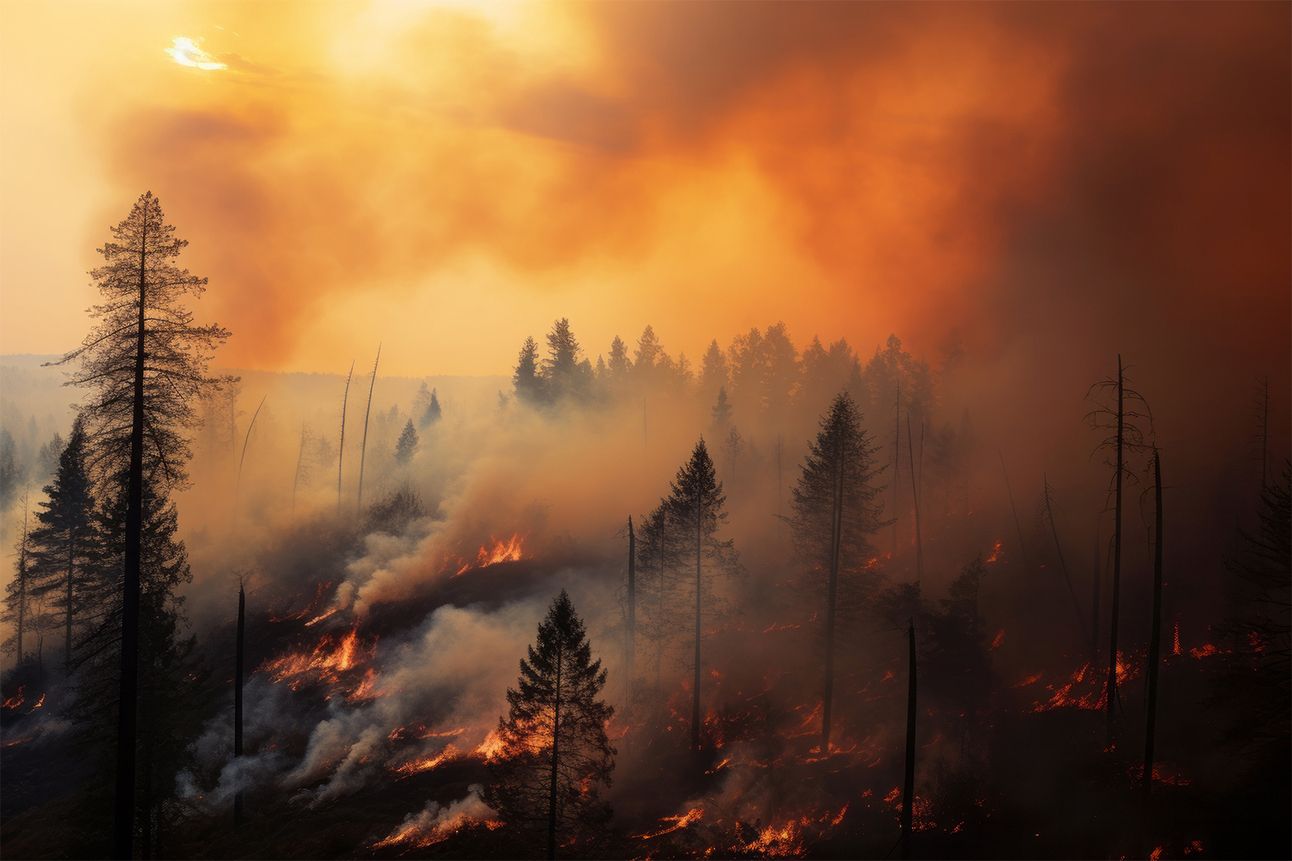
Ground-level zone isn’t a direct emission; it’s created when precursors such as methane, nitrogen oxides, carbon monoxide and volatile organic compounds react together with sunlight. These precursors include many anthropogenic sources — especially the burning of fossil fuels (in vehicles, by industry and at power plants) and via agriculture and wildfires, all of which crank up tropospheric ozone levels.
“The problem with ozone is it’s an incredibly active molecule and somewhat unstable in the environment. It interacts with everything it touches,” Nathan Borgford-Parnell, coordinator of the Scientific Advisory Panel and Science Affairs at the Climate & Clean Air Coalition, told Mongabay in an interview.
🌏 The Culture Column
📺 What we’re watching: When the Water Ends
📸 Profile of the week: @pure.rae.of.sunshinee
📖 What we’re reading: The Climate Casino: Risk, Uncertainty, and Economics for a Warming World, by William D. Nordhaus
🤯 Shocking fact we learnt this week: Livestock make up 62% of the world’s mammal biomass; humans account for 34%; and wild mammals are just 4%