- eco-nnect
- Posts
- ✊On how to build an activist
✊On how to build an activist
while pushing for the 3.5%.

Gaia Solaris
May 03, 2025
Dear activists, and activists in the making,
These last few weeks, I’ve found myself revisiting many of my earliest memories of climate and environmental activism (as you’ll see in the eco-story below). I’ve been thinking about when it all starts — that moment when something switches in our minds and compels us to act. What do we need to see to react? And more importantly, how can I transfer that sense of urgency to others, while our house is already on fire and most seem not to understand?
I guess it becomes clearer — or more obvious — when we find ourselves with no other choice. When we’re forced to fight for our land, the ecosystems we are a part of, the nature that sustains us. When no other solution exists, activism lights the way. Direct action becomes the only possibility.
It’s both a blessing and a curse that these moments of being forced into activism are happening in so many places around the world at once — like this week, when Hawaiian people were attacked by their central government while trying to protect the islands they call home. It certainly happened to many in Canada ahead of their elections, hence the results.
Activism moves the world. It moves us, defends us, and fights for us all.
I often find myself wondering what my life would be like if activism weren’t such a central part of it. If I wasn’t so focused on this path. And then I think about a couple of generations from now — about the children of today, and those yet to come — and the uncertainty they’ll face.
And I picture them, quite fairly, asking us — those who still had the ability to act — what we did. They look me straight in the eyes and ask, “What did you do when there was still a fighting chance?”“What did you do when you saw this coming?”
I think I know when my journey started. I don’t know where it will lead me, but I’m sure of one thing:
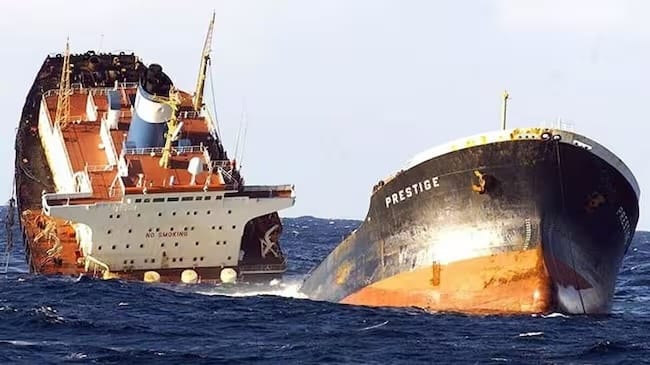
I will be able to say that, at the very least — like those who helped during the Prestige catastrophe — I truly tried my best.
Hopefully, there’s still plenty of time before that moment comes. And when it does, I’m sure we’ll be able to tell them how hopeless this all once seemed — and how, despite it all, we joined forces and fought.
🗞️ In Climate News
🇳🇿 State of emergency as high winds and floods hit New Zealand
The area of low pressure quickly deepened in the Tasman Sea off the west coast of New Zealand and travelled eastwards, with the centre of low pressure moving across the northern island and creating very strong winds, particularly through the Cook Strait, the body of water that separates the two islands.
🇺🇸 Justice department sues Michigan and Hawaii over climate suits against big oil
The suits, which legal experts say are unprecedented, mark the latest of the Trump administration’s attacks on environmental work and raise concern over states’ abilities to retain the power to take climate action without federal opposition.
🇬🇧 Lowest rainfall in 90 years as temperatures set to soar in Yorkshire
Just 78mm (3in) of rainfall has been recorded at Sheffield's Weston Park weather station since the start of February - the lowest since 1938.
Typically we would expect to see around 184mm (7in) and, by contrast, the same period in 2024 was the sixth wettest on record, when 300mm (11.8in) fell.
🇮🇳 Climate change-driven heatwaves hit Delhi’s Red Fort market traders
Researchers from Greenpeace India and the newly formed Workers’ Collective for Climate Justice South Asia interviewed ten market sellers from the huge Lal Qila (Red Fort) Market, as well as activists and social workers supporting this community.
🇺🇸 EPA moves to cancel nearly 800 climate justice grants issued under Biden
The U.S. Environmental Protection Agency plans to terminate 781 environmental justice grants aimed at protecting vulnerable communities, nearly doubling previous estimates and triggering legal battles over the move’s legality.
🇰🇷 South Korea's deadly fires made twice as likely by climate change, researchers say
Fires in the country's southeast blazed for nearly a week, killing 32 people and destroying around 5,000 buildings before they were brought under control in late March.
🇦🇺 Lake Bolac farmer found guilty of destroying Aboriginal rock formation
In 2021, the 65-year-old used an excavator to remove rocks from a 1,500-year-old, 300-metre-long stone arrangement resembling an eel on his Lake Bolac property.
The giant formation is known to Djap Wurrung traditional owners as the kuyang ceremonial ground and has been a recognised and registered site of Aboriginal significance since 1975.
🇨🇦 What Carney’s win means for environment and climate issues in Canada
Canada’s 2025 federal election campaign started on the heels of a prime minister stepping down and a tariff war brewing across the border. The dramatic twists upended what was an assumed Conservative win to instead keep the Liberals in power for their fourth consecutive term.
🇧🇷 Eucalyptus for Brazil’s steelmaking dries out communities in Minas Gerais
Acesita was privatized in 1992, and in 2011 the company and its plantations came under the control of Europe-based Aperam. Experts warn that these vast plantations have drained much of the water resources that once sustained the Alto Jequitinhonha Valley’s most marginalized communities, including quilombos, settlements established by formerly enslaved Africans.
📈 Cool Trends
♾️ eco-story
I met my six-year-old self last night.
She couldn’t sleep. She was scared.
She only wanted to talk about the seagulls and the cormorants, the fish and the dolphins she had seen covered in a thick, black layer—their feathers and wings glued together as they struggled to open them, their eyes shut. They were trying to survive under a petroleum blanket that spread faster than they could ever outrun it.
“Why?” she asked. “Why did they let it happen? Why are animals suffering? Why aren’t the waves moving? Why is the ocean black?”
I could have answered her. I could have explained that a handful of old men allowed it to happen. We could have talked about how they got away with it—how a carefully managed chain of irresponsibility and corruption let them walk free.
But she didn’t want to hear it. And even if she had, she wouldn’t have understood.
Twenty-three years later, I don’t think I understand it either.
🌏 The Culture Column
📺 What we’re watching: An Inconvenient Truth
📸 Profile of the week: @patiencenabukalu
📖 What we’re reading: Resistance Guide: How to Sustain the Movement to Win, by Paul Engler, Sophie Lasoff
🤯 Shocking fact we learnt this week: Nonviolent protests are twice as likely to succeed as armed conflicts, and those that engage a threshold of 3.5% of the population have virtually never failed to bring about change.